X

Chapter stories

Chapter, communicating out of a pandemic.

At times of crisis, businesses wonder what to say and how to say it. How to demonstrate genuine empathy and concern while surviving financial turmoil. How to communicate honestly and openly to their stakeholders while protecting their own reputation.

We’ve helped many clients weather storms over the past three decades but never has a challenge been as widespread, all-consuming and commercially devastating as this one. Yet despite the size of the mountain, the steps to the summit are conquerable. The fundamental principles of communicating in uncertain times and, more pertinently, communicating out of it can be achieved by following a formula that ensures your brand remains on message, is always authentic and maintains an identity that others want to associate with.

In this white paper we explore the six pillars of successfully communicating out of a pandemic, with step-by-step guidance and example case studies.

For access to the white paper, please email [email protected].

X

Chapter stories

The Tythe Barn

X

Chapter stories

Alrewas Hayes

Brand Strategy + Development | Key Messaging | Logo Design | Font, Colours + Textures | Image Library | Brand Toolkit | Website Design + Development | Print Suite | Retained PR and Social Media Campaign


The Alrewas Hayes story was a lovely one, they just needed our help to bring it to life. We worked with the team to develop their brand story, and curate a visual narrative that reflected the feel of their estate; a place that fuses historical charm with a contemporary style, for a brand aesthetic that’s elegant yet inviting.


X

Chapter stories

Bubble Food for London’s Food Banks

Bubble Food responded to the Covid-19 pandemic by repurposing their London facility to support struggling food banks. Overwhelmed by a sharp increase in demand coupled with a drop in donations, food banks found themselves in greater need than ever. Bubble Food committed to donating their commercial kitchens, packaging, chefs and administrative staff to keep local food banks operational and ensure the most vulnerable in society and still able to receive a nutritious meal.

X

Chapter stories

Country & Townhouse

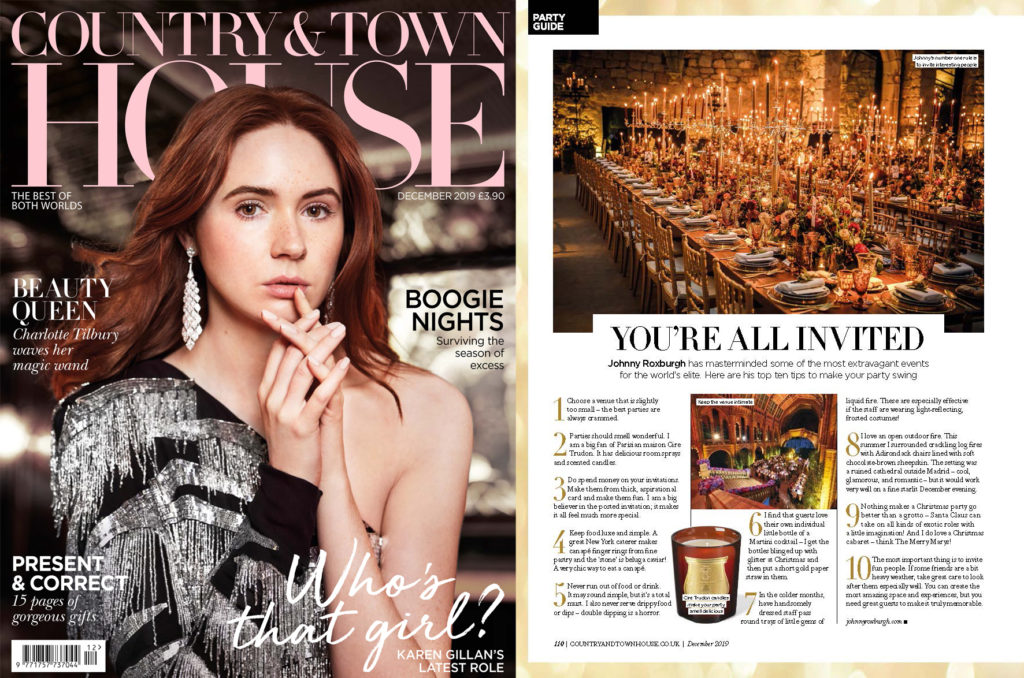
The Country and Townhouse annual Party Guide benefits from the wisdom of Johnny Roxburgh as he tells readers how to really make a party swing.

X

Chapter stories

Chelsea Barracks Kitchen by Ollie Dabbous

PR Strategy | Press + Influencer Engagement | Press Previews | Launch Events | Content Creation + Dissemination

Ollie Dabbous is one of a kind. So when Chapter was appointed to launch Chelsea Barracks Kitchen – an initiative by London’s most anticipated new development Chelsea Barracks in Belgravia in partnership with the chef wunderkind – it was a mouth-watering proposition.

With little more than a three week lead-in, Chapter’s PR team strategised a series of teaser launch events timed to coincide with the world-famous Chelsea Flower Show. The Michelin-starred chef prepared a sample of the menu which included candy-striped beetroot with marigold, toasted pistachio & Sussex slipcote, papillote of Gigha halibut, Cornish mussels & yellow courgette in a nasturtium broth, and for dessert, a heavenly orange blossom custard doughnut.

Once the doors opened to the pop-up restaurant, situated in the 12.8 acre site that’s been out of reach for over 150 years and developed by Qatari Diar Europe, the PR campaign resulted in 63 pieces of coverage in the likes of FT How To Spend It, The Telegraph, Country & Townhouse, Esquire, Hot Dinners, SheerLuxe and Town & Country.

The pop-up was a sell-out success and Chapter has been retained to handle future openings.

PROJECT PARTNERS: Restaurant Design & Styling: LAMP | Menu Design: Ollie Dabbous and HIDE | Catering Operations: Bubble Food | Flowers: Amie Bone Flowers
X

Chapter stories

William Foyle X Arteviste

A Review of William Foyle: Landscapes at Asia House, London

Entering Asia House, I was immediately struck by the overflow of glittering figures adorned in all manner of extravagance; each in silent competition with the other. Air kisses were exchanged, delicately gloved hands waved at exquisitely tailored suits, crisp bubbling champagne was poured, and at the centre of this frenetic whirlpool was Scottish artist William Foyle and his eleven landscapes.

Before my arrival, I had satisfied my curiosity by exploring Foyle’s previous work and trying to absorb all that I could about his young and impressive career. From the articles I had perused and the works I had committed to memory, a vague image of the artists externally imposed persona had begun to take shape. I knew Foyle had been declared  ‘one to watch’ by Sir Timothy Clifford at only eighteen and had been heralded as the ‘Francis Bacon of tomorrow’ a few years later. These monikers of preordained greatness echoed in my mind as I descended a winding marble staircase to the exhibition itself. Were these declarations intended to colour my impending experience or were they destined to validate it? Was William Foyle’s reputation as a protégé of virtuosity deliberately romanticised or did unadulterated talent flow out of him organically and claim that mantle as its birthright?

Breathtaking. Jolting. Humbling. Upon entering the gallery rooms, my growing fear, that the myth of the man was more potent than his works, melted away. Warm, watery images of landscapes punctuated each wall like portals looking out to another world. Murky inclinations, hazy memories, enigmatic horizons all rose before me on a scale that rivalled the impact felt at Musée des Impressionnismes Giverny.

Foyle’s balmy works, Scotland II and Indian III, in particular, pulsated with glowing light – as if they were backlight by the iridescent kiss of the sun. This expert rendering of light and shadow can be partially accredited to Foyle’s use of burnt umber and burnt sienna (also known as terra rossa), pigments employed religiously by Renaissance masters like Rembrandt (1606-1669), Titian (1488-1576) and Caravaggio (1571-1610). Foyle’s illusions of luminosity created such an extreme sense of depth in each image that it was as if I were looking through frosted glass; squinting with childlike fascination in an attempt to behold the blurred landscape beyond. A wonderfully unattainable dream.

These surprisingly romantic images were so contradictory to what I had begun to associate with Foyle. His 2015 works, Holocaust Figures I-V and Showers in Lodz Ghetto I & II, had held my heart in a beautifully painful vice grip as a result of their raw desolation and pain. These latest creations, by contrast, slowly filled my heart with longing the way winking stars slowly saturate an endless night sky.

Following an unexplainable pull, I navigated my way through the throngs of fashionable collectors and admirers until I reached Easter at Borrobol, Sutherland. It stood in dignified grandeur, a mammoth wall of cerulean blue marked with inky lines of viridian which liquified into a gleaming moss-green expanse. I looked down at the catalogue image in my hands and back up at the painting itself in immediate disbelief. The photograph, I decided indignantly, was practically an insult to the shimmering, living thing that towered before me. Having already considered several of the other landscapes, I found that like them, Easter at Borrobol, Sutherland’s glassy surface was ruptured with deliberately unblended dollops of paint.

These abrupt smatterings of thick paint acted as evidence of Foyle’s manual labour, along with his broad, brazen brushstrokes that functioned like fingerprints across the canvas face. Serving as a poignant reminder that the surreal scene in front of me was the result of Foyle’s hands, the strokes were unapologetically visible and often unanimously horizontal or entirely vertical. Their decisive direction added a cutting sense of motion that undoubtedly mimicked the distortion of form often experienced when gazing out the window of a moving vehicle. You could feel the speed, the temporality, the wind, the journey.

But whose journey was it? Surely we all go on a personal pilgrimage when we immerse ourselves in an exhibition, but we are also simultaneously attempting to slip into the artist’s skin; to see what they saw and feel what they felt. A masterclass in the art of empathy. Luckily for me, I was able to speak with the ‘man of the hour’ after he had been gushed over by the latest pair of adoring supporters who had catapulted themselves towards him the moment he had come up for air. In an endearingly comical situation, William Foyle seemed genuinely gracious and unfailingly patient.

As I told him about my infatuation with Easter at Borrobol, Sutherland, Foyle began to indulge my enthusiasm with a variety of insights into his physical process of creation and the genesis of the exhibition. When crafting his alluring compositions, Foyle described his ritual of painting primarily in the afternoon and how his landscapes frequently materialised into images that were far from his original intention. Abashedly, he smiled as he recalled often being submerged in his work for hours, only to resurface and realise with bewilderment that it was evening. Evidently, these hypnotic landscapes transfixed the artist as well as us viewers.

Foyle explained, amidst the attention of the gallery photographers and the greetings of passersby, how after his 2015 exhibition he had run towards solitude and ventured into the unknown, driving around Eastern Europe in search of fulfilment. Resembling a restless nomad, Foyle had set off through Hungary, Serbia, Bulgaria, Romania, and Slovakia, eventually extending his odyssey to Turkey, North Africa and India. The window of a train became the lens through which Foyle began to ruminate on the landscapes of these unfamiliar places and gradually this contemplative experience developed into the core concept of the exhibition.

With each landscape, Foyle submerges us in specific memories of his four-year quest for inspiration; with every piece being modelled off a single photo he’d personally taken. It was evident, by the names of the works (many of which were names of countries), the exhibition title Landscapes, and Foyle’s underscoring to me that the paintings are based on real locations, that he intends to be placed in the broader narrative of landscape painting. I would also add that, by defining the vantage point of his works as being the window of a train, Foyle is unavoidably placing himself in competition with the likes of contemporary artist Philippe Cognée. More specifically, Cognée’s latest abstracted landscapes of the Indian countryside observed from the window of a rocketing train.

Unlike Cognée, however, Foyle has elevated his landscapes to a level approaching those produced by the esteemed nineteenth-century British landscape artist J.M.W. Turner (1775-1851). Although Turner’s later landscapes only teetered on the edge of true abstraction, Foyle has managed to channel the same sense of mystery found in Turner’s Yacht Approaching the Coast (c.1840-45), and Seascape with Distant Coast (c.1840). Like Turner, Foyle illuminates his landscapes with a masterful rendering of light that charge his scenes with a tempest of emotion, distinguishing his works from the monotony commonly associated with the perennial subject matter. Moreover, Foyle mirrors Turner’s eerie ability to elicit a sense of longing from the viewer; as if the bitter-sweet yearning had poured out of the artist himself and onto the pallet in an emotional catharsis that inevitably washes over the viewer like a resolute wave.

While too indecipherable to be considered classically impressionistic, Foyle’s mighty square creations can loosely be defined as belonging to the canon of abstract expressionism and colour field painting. Foyle’s gestural brushstrokes and seemingly random paint spatters speak to the core qualities of abstract expressionism; a style often defined by ‘mark-making’ and the impression of spontaneity.

Similarly to the oeuvres of Mark Rothko (1903-1970), a pioneer of the New York abstract expressionist style, and Jules Olitski (1922-2007), one of history’s most prolific colour field painters, Foyle uses large swathes of solid colour and nebulous forms to bewitch the viewer and produce a meditative response. Like Barnett Newman (1905-1970), a contemporary of both Rothko and Olitski, Foyle has punctured his vast fields of pigment with substantial lines or ‘zips,’ as Newman referred to them, which define the spatial structure of the composition. While Newman’s ‘zips’ were characteristically harsh and executed with impassive brushwork, Foyle has stayed closer to the emotive tradition of Rothko by executing his ‘zips’ with expressive strokes.

At just twenty-six and with Landscapes being his fourth solo show, it would appear that Foyle’s prophesied fate as a consummate innovator may be coming to fruition. While artists rarely contemplate their place in Art History, we critics usually agonise over who will ultimately be worthy of ink. Who moved the needle forward? Who bravely built on the visual language chartered by the greats? It’s impossible to say for certain, but if I were a betting woman, I would wager that William Foyle’s mystifying landscapes will leave in their wake an indelible emotional and academic impact.


Read the full article here


Credits- Written by: Maya Asha | Venue: Asia House | Photography: Naomi Goggin


X

Chapter stories

Millbridge Court

Brand Strategy + Development | Key Messaging | Logo Design | Fonts, Colours + Textures | Brand Toolkit | Website Design + Development | Collateral design | Retained PR Campaign

For Millbridge Court, it’s all in the details.

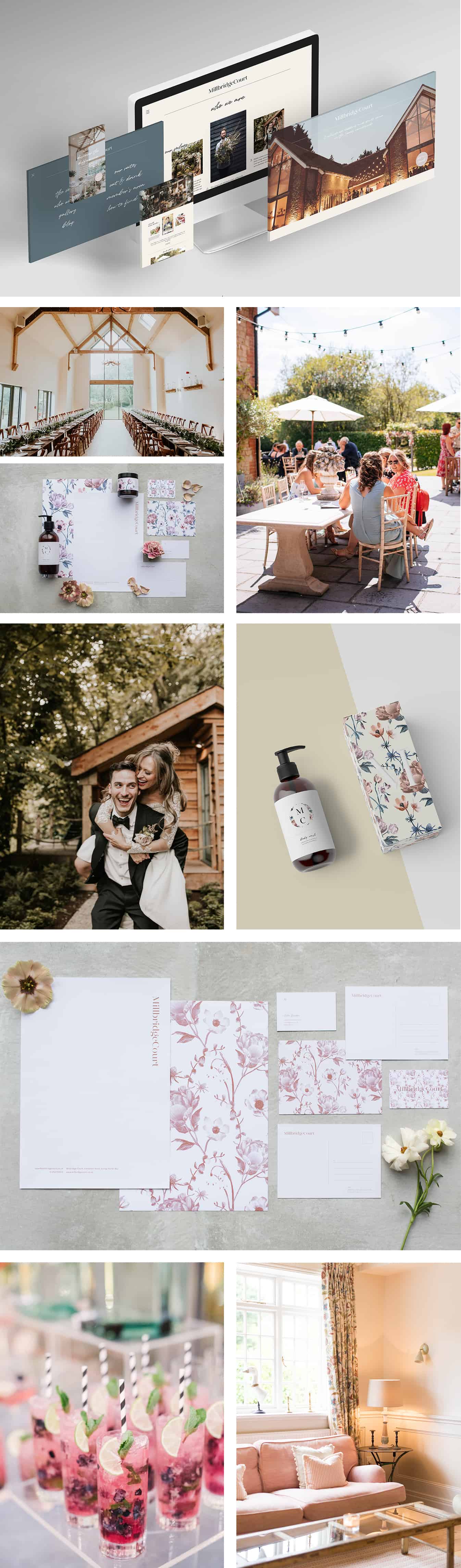
Luxurious yet understated, this Surrey based wedding and events venue is purposefully feminine, style focused and youth-driven. A place where city chic meets country charm.

Since its launch in 2014, the business has evolved and expanded, redefining the perception of a classic country barn venue. Yet the brand identity had been left trailing behind.

Working closely with the team, we committed to conceptualising and designing a new brand image that conveyed a strong sense of personality, contemporary style and attention to detail. Taking inspiration from the distinctive details that set Millbridge Court apart – from the architectural design and interior styling to the emphasis on exceptional food, quality and service – our studio team developed a visual narrative that tells the story of the brand, its values and the experience.

Muted colours, elegant detail-rich fonts and hand illustrated patterning illustrate the brand’s ‘boutique hotel’ vibe, while a sophisticated brand marque brings the venue’s architectural details to life.

For the web design a seamless navigation experience was created, taking the user on a journey through the venue and evoking a true sense of what to expect during a visit. A private members’ portal was also built to offer booked clients exclusive access to a host of additional resources.

The reins have now been handed over to our PR team to share the Millbridge Court brand story far and wide.

www.millbridgecourt.co.uk


X

Chapter stories

There’s something about Mary

“Fashion is not frivolous: it is part of being alive today.” 


The woman who singlehandedly revolutionised the British high street, Mary Quant personifies the swinging sixties, bursting onto the scene with her miniskirts, daisy prints and iconic five point bob. She shook up society from the misery of post-war Britain, and put the fun back into fashion by empowering women to be bolder, go shorted and just feel free in expressing their individuality. As her first major exhibition launching at the V&A, Floral Engineers Blooming Haus have created five unique floral arrangements inspired by the iconic designer, a true pioneer of the 60’s.


One | The Monochrome

Quant’s creations were uniform, with simple colour palettes, and bold prime colours. The cuts were simple, the lines emphasised. Blooming Haus combine soft red Lisianthus with deep pink Anthurium for an arrangement that bursts with life and oozes femininity.

Two | The Spirited Chic

Playful yet sophisticated, a bouquet that champions delicacy but with a very modern approach. With lilac Rosa and pure white Lisianthus drawing your immediate attention, your eyes are then led to dance around the arrangement, discovering the unique textures and frills of the Astible Washington and Gathered Spirea, a Quant classic.

Three | The Vibrant

Pillarbox red, buttercup yellow, gaudy green. Scooped necklines and rising hemlines demanding to be seen. Blooming Haus have incorporated Ranunculus Pon-Pon Merlino with Acacia Blossom for an arrangement that emulates the whimsy and kitsch of Quant’s colour palette.

Four | The Bauhaus

With Mod culture in its prime, and at a time when the Bauhaus movement was only really just beginning, this arrangement takes inspiration from Quant’s sharp graphic lines, and geometric forms. Modern and conceptual, Blooming Haus have used Gloriosa Superba and Ranunculus Butterfly to create a riot of colour that is skilfully still uniform.

Five | The Androgynous

Sexy, sporty, short. Quant’s vivacious energy is complemented here in the use of Syringa Dark Koster, Rosa Purple and Gathered Grasses, which bursts with life and colour to create an arrangement that is dynamic yet elegant. The black Anthurium perfectly emulating that iconic PVC raincoat.


www.bloominghaus.com

X

Chapter stories

International Women’s Day

International Women’s Day is one of our favourite days of the year, and one that we feel is so important to share in and celebrate. We’re lucky enough to work in an industry that has many very talented women at the forefront, and so we wanted to shine a light on those incredible women who are excelling in their field and inspiring others to do the same. We asked a selection of empowering women who have built their own successful businesses for their advice of who they look up to as an inspiration, what trait they credit to their success, and what they would tell their younger selves starting out in the industry if they had the opportunity. Here’s what they said.

Ali Beaven  |  Prezola

Who has been your biggest inspiration throughout your career, and why? 

I have always been inspired by Chrissie Rucker OBE, founder of The White Company. We work closely with them as one of our Brand Partners and her business growth story is phenomenal.

What trait do you credit to your own personal success?

I am good at understanding people and creating a good company culture. Having such a happy, hardworking team around me has definitely contributed to our success.

What advice would you give to your younger self?

Pick your battles and don’t worry about the small stuff. Oh and do more exercise!

Jade Beer  |  Brides Magazine

Who has been your biggest inspiration throughout your career, and why?

I think the five years I was the Deputy Editor at Glamour were some of the most inspirational of my career. I was surrounded by women who genuinely loved their jobs and brilliantly combined creativity with humour and tenacity. Everyone wanted to excel but never at the expense of someone else.

What trait do you credit to your own personal success?

Surrounding yourself with talented people is always a good idea, you can only benefit from it, but you also have to be prepared to work very hard and reach for the same high standard in everything you do.

What advice would you give to your younger self?

I would tell my younger self to lay off the spray tans. I seem to have spent most of my 20’s the colour orange. We all did!

Kim Balasubramaniam  |  Kim Balasubramaniam

Who has been your biggest inspiration throughout your career, and why?

My biggest inspiration has always been my clients themselves. I have worked with many strong, successful women over the years and to see how they have each embraced a new chapter of their life and approached the planning of their wedding has inspired me to continue to serve them as best I can.

What trait do you credit to your own personal success?

Tenacity and kindness. I don’t believe you have to be ruthless to be successful and believe much of my success has been down to the significant relationships I have made with my peers over the years.

What advice would you give to your younger self?

To be true to myself. I spent many a year trying to be something I wasn’t; we all have our own unique gifts and personalities to bring to the table. Once we recognise and understand what they are, they can bring us great strength and power.

Lotte Martin  |  LAMP Productions

Who has been your biggest inspiration throughout your career, and why?

I can’t pin point it down to one person – it’s too difficult, but each and every day I am inspired by my peers and contemporaries – male and female – that soldier on and succeed in their own way whilst positively supporting those around them. Running a business isn’t easy but, my god, it’s rewarding – being able to share and be supported by those doing the same thing will continue to inspire me for years to come.

What trait do you credit to your own personal success?

My ability to get on with people, and treating everyone that I come into contact with as equals. These are both often discounted as useful tools, but they are invaluable in building a great support network around you. Without a good network of people who you know, trust and get on with, it can be almost impossible to deliver.

What advice would you give to your younger self?

Consider every opportunity really carefully, be it big or small. Some offers may seem irrelevant or inconsequential but turn out to be the best opportunities, whilst others could seem amazing on paper but not so great in reality! Weigh up the pros and cons of each one – but don’t spend too long on each decision, as they may pass you by!

Anna McGregor  |  LAMP Productions

Who has been your biggest inspiration throughout your career, and why?

My son. He pushes me to work harder and be the best I can be. Bringing him up as a single parent while running a business is a huge challenge but it’s worth it a million times over. Every day he inspires me to keep on going while helping me see things with more clarity.

What trait do you credit to your own personal success?

Integrity. Be kind to people, be honest and do your very best…that’s the lesson I take with me each day as I navigate an ever challenging and fast growing industry.

What advice would you give to your younger self?

Don’t always put work first. I missed so many special occasions with family and friends when I kept saying yes to the next job. Finding balance may be difficult, but it’s certainly not impossible. I would remind my younger self that the world won’t collapse around me if I was to take the odd day off.

Lisa Burton  |  Luvana

Who has been your biggest inspiration throughout your career, and why?

My biggest inspiration is my 9 year old daughter. Until I had her I was very driven and worked very long hours towards my 5 and 10 year goals; when Olympia came along she turned my world upside down, in a positive way. I’ve learnt so much from her, observing her zest for life, her natural creativity and her joy at the simple things…she’s a joy to parent. So although I’m still very driven, she’s softened me and inspired me to strive for that lucid work life balance which for me now is my idea of success.

What trait do you credit to your own personal success?

I think my success comes from setting clear small achievable goals, whilst working towards one large goal. I’ve also learnt that working hard doesn’t necessarily mean working long hours. I’ve learnt to trust my instinct and up to now it’s never let me down. Ever since I was a child, I’ve had this strong desire to be successful at whatever I do, it doesn’t mean I always am, but I’m not afraid of making mistakes, picking myself up and starting again. For me failing isn’t an option, if my original plan doesn’t work, I’ll re-evaluate and make another plan.

What advice would you give to your younger self?

If I could tell my younger self anything, it would be to believe more in yourself and ignore the naysayers (even when they’re really loud), trust your instinct and design a life that makes you happy.

Helen Sharland  |  Cutture

Who has been your biggest inspiration throughout your career, and why?

I am always inspired by friends and colleagues daily – of which I have an eclectic mix! These may be stay at home mums who are managing their household in interesting ways, working mums who are owning their days fulfilling life both at work and home, as well as high profile business owners who have done incredible things with their businesses. I am a huge fan of Mary Portas and Holly Tucker who are both running admirable businesses and campaigning for creative businesses and women in business.

What trait do you credit to your own personal success?

I am a hugely under confident person, however I do seem to have a stubborn streak which makes me think differently. I always like to challenge the ‘norm’, not doing anything the conventional way which I think flows throughout my creative thinking – always questioning ‘why is it done that way, can’t we try thinking about it this way?’ n.b This is not always a positive trait and very annoying for others! Being a busy business owner and mum of three, a head for logistics and lateral thinking is also a must!

What advice would you give to your younger self?

Please stop worrying about what others think, people actually value you and your opinion, you are not the same as anyone else, and you’re ok, actually.

Sandra von Riekhoff  |  Divine Day Photography

Who has been your biggest inspiration throughout your career, and why?

There are so many that do this so naming one is impossible, but they all own the same trait…they imagine and jump! I’m fascinated by people who dream and do in equal measure.

What trait do you credit to your own personal success?

People! Nothing truly valuable can be done alone.

What advice would you give to your younger self?

To simply remember that we all need love and acknowledgement. And as Walt Whitman put it “I have learned that to be with those I like is enough”.

Natasha Beckman  |  Urban Soul Orchestra

Who has been your biggest inspiration throughout your career, and why?

My mother has been a huge inspiration to me as she is the most positive person I know. She has one particular belief, “nothing is impossible” which has always resonated with me.

What trait do you credit to your own personal success?

I love people and have always put a lot of energy into relationships, across a wide range of stakeholders, from clients, to artists and collaborators, many of which have spanned several decades as I have always invested in the long term. I am aware that I am a hard worker, and unfortunately as much as I’d like to suggest a magical life hack I don’t think there is a substitute for putting in the hours.

What advice would you give to your younger self?

I would encourage her to love herself and be confident. When I have the privilege of spending time around some of the inspiring young women of today, this is something I try to encourage in them also.

Rosanna Garden  |  Motee Maids

Who has been your biggest inspiration throughout your career, and why?

I haven’t really had mentors, just work hard and don’t be afraid to try it your own way.

What trait do you credit to your own personal success?

Tenacity and hard work. Also questioning and understanding, you can never have too much knowledge. Find out as much information as you can about how and why things are done.

What advice would you give to your younger self?

Try even more things, it is all experience.


#balanceforbetter

CLOSE X

Apply today

    CLOSE X

    Get in touch